Here's something most Chicago couples learn too late: your venue choice decides about half of your dance floor's fate before a single song plays. Room shape, ceiling height, where the bar sits, how far the sound carries — it all matters. We've DJ'd hundreds of receptions across Chicagoland, from Fulton Market lofts to Gold Coast ballrooms to barns out past Naperville. Here's our honest ranking of the seven most common Chicago venue types, purely by one metric: how packed your dance floor will be.
1. Industrial lofts (Fulton Market, West Loop, River West)
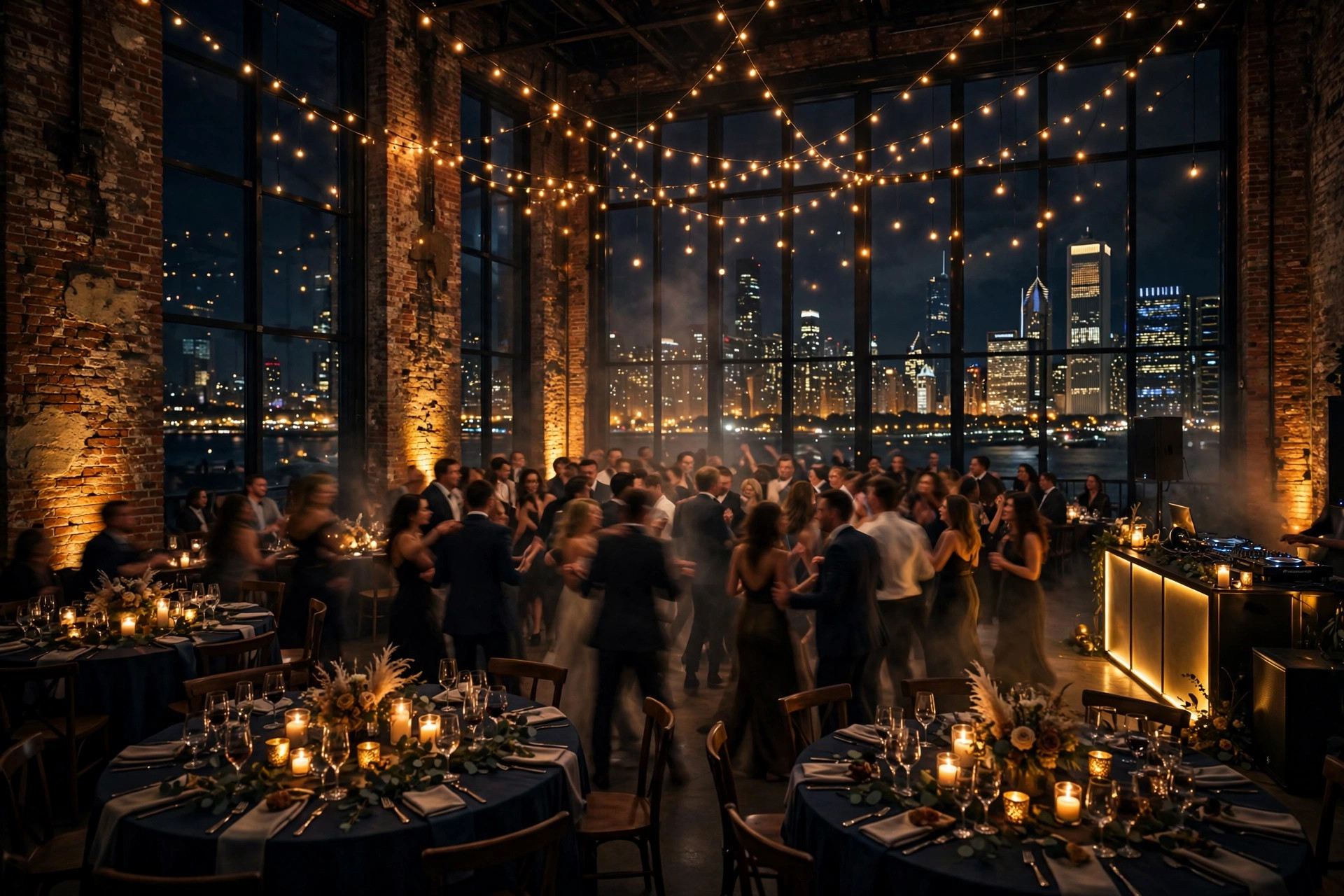
The reigning champions. Exposed brick, one big open room, high ceilings that let the sound bloom — lofts were basically designed by accident to be perfect for dancing. The layout keeps everyone in one space, so nobody wanders off to a far wing. The dark industrial vibe also makes lighting look incredible. If your priority is a packed, sweaty, 11pm-style dance floor, this is your lane. Watch for: concrete floors can get loud and echoey, and some lofts have strict sound limiters — ask before you book.
2. Historic ballrooms (Gold Coast, Loop, South Loop)
Think grand hotel ballrooms and century-old theaters: ornate, dramatic, and usually laid out with the dance floor dead center like a stage. The symmetry works in your favor — tables ring the dance floor, so everyone's attention funnels inward. A DJ in a ballroom gets to play showman, and the room plays along. Watch for: some historic spaces have sound restrictions or early hard-stop times for amplified music. Confirm the cutoff before you fall in love with the chandeliers.
3. Breweries and distilleries (Logan Square, Pilsen, Ravenswood)
The fun wildcard. Breweries skew toward high-energy crowds — your guests are already in a casual, party-ready mood, and the vibe translates directly to the dance floor. Industrial-chic rooms with long communal tables keep the energy social and loose. Watch for: tank rooms and metal everywhere bounce sound hard, so your DJ needs to tune the system for the space. Also confirm they allow outside vendors — some taprooms have in-house-only rules.
4. Downtown hotel ballrooms (The Loop, River North)
The reliable workhorse. Purpose-built event rooms with great acoustics, proper power, loading docks for gear, and staff who've run a thousand weddings. Nothing about them is risky — which is exactly why they're boring in the best way for your DJ. Your dance floor won't die here unless the crowd does. Watch for: hotel ballrooms can feel corporate if you don't dress them up — this is where up-lighting and a monogram pay for themselves fast.
5. Lakefront spaces (Navy Pier, Museum Campus, lake-view rooftops)
Unbeatable views, unbeatable photo ops. The energy is electric during golden hour — guests are outside on the terrace, drinks in hand, city behind them. The catch is the transition: when everyone comes back inside for dancing, the DJ has about fifteen minutes to rebuild the room's momentum. A good MC earns their money here. Watch for: wind is the enemy of outdoor ceremonies and cocktail hours — have the tent/contingency plan in writing.
6. Suburban barns and estates (Kane County, Naperville, Lake Forest)
Barns are gorgeous and the sunset photos are unreal. For the dance floor, though, they're a split decision. Open timber frames look amazing but scatter sound, and many barns split the layout across multiple rooms — cocktail hour in the silo, dinner in the tent, dancing in the barn — which fractures your crowd. The fix is simple: keep the whole night in one big space when you can. Watch for: rural power limitations. Ask whether the venue can handle a full DJ rig plus lighting without tripping breakers mid-toast.
7. Restaurants and private clubs (Lincoln Park, Wicker Park, the suburbs)
Intimate, great food, built-in ambiance. But restaurant layouts were designed for dining, not dancing — the "dance floor" is often a cleared patch between tables, which means your crowd is spread thin. For smaller weddings (under 80 guests) this can actually be perfect: an intimate room with everyone close feels electric. For 150 guests? You'll lose people to the bar across the room. Watch for: noise ordinances in residential neighborhoods — Lincoln Park and Wicker Park venues often have firm outdoor cutoffs.
The questions to ask any venue
Whichever type you lean toward, ask these four things before you sign:
- What's the hard stop time for amplified music — and is it negotiable?
- Are there sound limiters or decibel restrictions in the room?
- Can the dance floor fit your guest count — comfortably, not shoulder-to-shoulder?
- Where do the bar, restrooms, and photo booth sit relative to the dance floor? (Everything pulls people away from it.)
The straightforward take
No venue is a dealbreaker — we've packed dance floors in barns, breweries, and basements. But the right room gives your DJ a head start, and the wrong layout means working twice as hard for the same energy. When you tour venues, picture the room at 9:30pm: where's the dance floor, where's the bar, and is anything between them? If you can answer that, you'll pick right.
Our wedding package is $995 for 5 hours — professional DJ + MC, premium sound, lighting, custom playlists, and live requests, with experience in every venue type on this list across Chicagoland. See what's included in the $995 package or check your date — serving Chicagoland, and Saturdays go first.